Learning goals
Place transient rotor-angle security in the IEEE/CIGRE stability picture
Define stable/unstable labels under an explicit horizon and criterion
Define critical clearing time (CCT) as a scenario property (a security margin)
Report signed CCT error and false-safe rate — not accuracy alone
Reading
IEEE/CIGRE stability classification Kundur et al., 2004Hatziargyriou et al., 2021; transient stability chapters of Kundur & Malik (2022)
Dynamic security (short)
Dynamic security is the ability of the grid, in its present operating condition, to remain stable after credible disturbances such as short circuits. Assessment checks whether machines (and, later, converters) keep synchronism and whether a margin such as CCT remains adequate.
That framing comes from IEEE/CIGRE stability and security language Kundur et al., 2004Hatziargyriou et al., 2021.
Where this sits in power system stability
In the IEEE/CIGRE framework, post-fault transient rotor-angle behaviour belongs under rotor-angle stability. The 2020/2021 revision adds converter-driven and resonance stability. These categories place TSA and CCT in a wider picture; SciML for PS Lab 5 starts with classical rotor-angle / SMIB CCT before converter electives.
Power system stability classification, redrawn for this book after the IEEE/CIGRE task-force definitions Kundur et al., 2004Hatziargyriou et al., 2021. Teaching focus here: rotor-angle stability and its transient branch; converter-driven stability appears in later electives.
Transient stability — three qualitative cases
Transient stability is the ability to maintain synchronism after a severe transient disturbance. Rotor angles undergo large excursions; the outcome depends on the initial operating state and the severity of the disturbance.
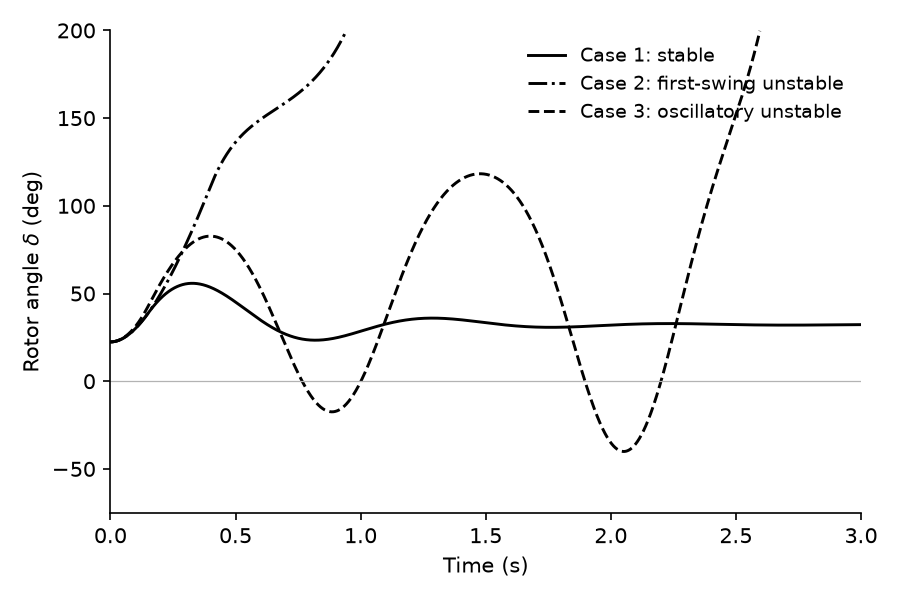
Rotor-angle response to a three-phase fault on the classical SMIB model (sciml_ps.smib, regenerated by scripts/make_figures.py). Case 2 clears the fault too late; Case 3 uses slightly negative damping to mimic poorly damped controls.
Stable. The angle rises to a maximum, then falls and oscillates with decreasing amplitude toward a new steady state.
First-swing instability. The angle keeps increasing until synchronism is lost (often insufficient synchronizing torque).
Oscillatory instability. The first swing looks acceptable, but growing oscillations later drive loss of synchronism.
Classical multimachine TSA study windows are often about 3–5 seconds (longer, ~10 s, when slow interarea modes dominate). With converters, the critical post-fault interval can be shorter, and assessment may need converter-driven phenomena as well as rotor-angle behaviour Hatziargyriou et al., 2021. Finite-horizon simulation labels used in labs are operational, not asymptotic Lyapunov certificates.
Critical clearing time
CCT is the longest fault-on duration for which the system remains transiently stable after clearing, under a stated stability rule (angle threshold, simulator flag, horizon, …).
Clearing later than CCT leads to instability (e.g. loss of synchronism) after clearance. CCT is a property of the operating point + contingency + model + criterion, not of a neural network.
TSA asks whether synchronism is kept after a disturbance. Operations also need a margin: how long can a fault remain before stability is lost? CCT is one such measure.
Operational search
Practitioners often estimate CCT by bisection or grid search over clearing time, assuming a monotone stable→unstable transition inside a bracket. If no valid bracket exists, label the case — do not invent a CCT.
Metrics
| Metric | Meaning |
|---|---|
| Signed CCT error | Positive values overestimate available clearing time (dangerous) |
| Absolute CCT error | Magnitude of mistake |
| False-safe rate | Fraction of truly unstable cases predicted stable |
Accuracy alone can hide an unacceptable false-safe imbalance. Test boundary-adjacent scenarios separately from easy cases.
Lab
Classical check when assumptions allow: Direct methods
Further reading
Direct methods for an independent equal-area check on CCT
Surrogate models for stability tasks for learned labels and margins
Common misconceptions
Calling a finite-horizon label a Lyapunov proof
Using trajectory NRMSE as a proxy for CCT quality
Ignoring bracket saturation in bisection
Treating CCT as a property of a trained network rather than of the scenario + criterion
- Kundur, P., Paserba, J., Ajjarapu, V., Andersson, G., Bose, A., Canizares, C., Hatziargyriou, N., Hill, D. J., Stankovic, A., Taylor, C., Van Cutsem, T., & Vittal, V. (2004). Definition and Classification of Power System Stability IEEE/CIGRE Joint Task Force on Stability Terms and Definitions. IEEE Transactions on Power Systems, 19(3), 1387–1401. 10.1109/TPWRS.2004.825981
- Hatziargyriou, N., Milanovic, J., Rahmann, C., Ajjarapu, V., Canizares, C., Erlich, I., Hill, D., Hiskens, I., Kamwa, I., Pal, B., Pourbeik, P., Sanchez-Gasca, J., Stankovic, A., Van Cutsem, T., Vittal, V., & Vournas, C. (2021). Definition and Classification of Power System Stability – Revisited & Extended. IEEE Transactions on Power Systems, 36(4), 3271–3281. 10.1109/TPWRS.2020.3041774
- Kundur, P., & Malik, O. P. (2022). Power System Stability and Control (Second). McGraw-Hill Education. https://openlibrary.org/isbn/9781260473544